
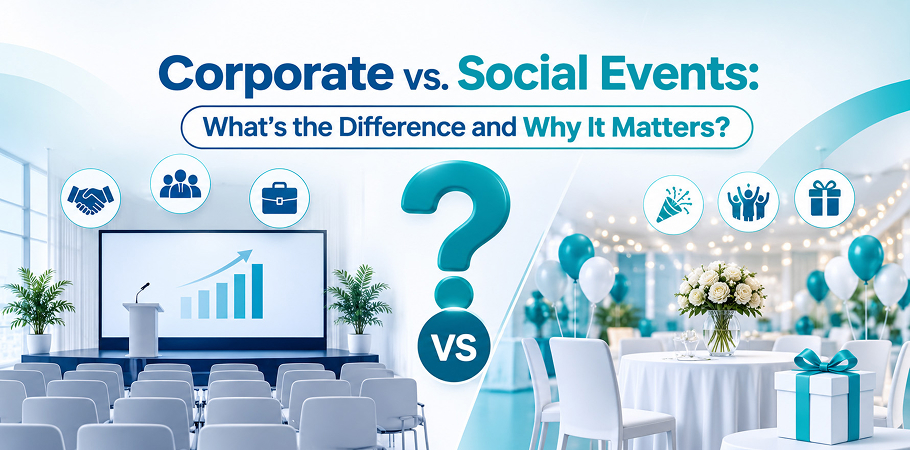
Although both types of events bring people together, the work behind them can look quite different. Corporate events need to support business priorities and represent an organisation appropriately. Social events are shaped more by the occasion, the host’s preferences, and the experience guests are meant to enjoy.
Understanding corporate vs. social events helps you make better decisions about the format, venue, budget, programme, and people involved. It also helps you identify which arrangements need the most attention before the event begins.
This guide looks at how the two types of events differ, where they overlap, and what organisers should consider when planning either one.
What Is a Corporate Event?
A corporate event has been planned by any business or professional entity to achieve a specific purpose connected to business. The objective can be to share information with coworkers or customers, launch a product, enhance relations with business partners, reward employees, or gather people around a common aim.
Those who take part in such events include employees, management, vendors, customers, and other business professionals. The format of the event depends on those taking part and its objectives.
For instance, if a corporation presents a new good, it may need a presentation area and room for guests with a chance to ask questions. An annual corporate event may require employee recognition, entertainment, speeches from executives, and networking opportunities for teams.
Popular Types of Corporate Events
Conferences and seminars: Offer a place for presentations, knowledge-sharing, and exchange of information about industry insights while networking.
Product launches: Promote a new product or service to a target audience via demonstrations, presentations, and experience.
Annual days and award nights: Celebrate successes, highlight milestones achieved by the company, and unite employees.
Dealer and retailer meetings: Provide an opportunity for businesses to talk about different business matters, including plans, products, and relationships with channel partners.
Team-building: Take part in team events that allow participants to work together in a relaxed atmosphere and open new channels of communication.
Meetings and incentive programs: Engage in a meeting related to the recognition of employees, partners or other company goals.
Corporate events can be held at the office, hotels, conference venues, exhibition venues, outdoor locations etc. Some events combine physical and online attendance.
The important consideration is how each part of the event supports its purpose. The programme, venue, branding, technical setup, and guest experience should work together rather than operate as separate arrangements.
What Is a Social Event?
A social event is held to mark a special occasion, to enable people to meet and have fun together. It is different from business events in that it is determined by the host’s taste, relationships, traditions, and the desired atmosphere.
These events can be small, simple, huge and very elaborate. For instance, to organise a birthday dinner, there is a need to find a proper place and make a few arrangements, but a wedding will require many events, lists of guests, and arrangements.
Common Types of Social Events
- Weddings and engagement celebrations: Bring family and friends together for important personal milestones.
- Birthday parties and anniversaries: Celebrate special dates through food, decorations, activities, and entertainment.
- Family reunions: Give relatives an opportunity to reconnect and spend time together.
- Festive gatherings: Celebrate cultural, seasonal, or family traditions.
- Community events: Encourage participation and interaction among people with a shared interest or connection.
- Private celebrations: Include dinners, milestone parties, and other gatherings organised around personal occasions.
The planning priorities depend on the type of celebration. One host may want a relaxed gathering where guests can talk comfortably, while another may prefer a themed event with performances and a detailed programme.
Social events are not necessarily simpler than corporate events. A large celebration may involve just as much coordination, budgeting, and contingency planning as a business function. The difference is that decisions are usually guided by the occasion and the host’s expectations rather than formal business objectives.
Corporate vs. Social Events: Key Difference
The distinction becomes clearer when you look at the decisions organisers need to make. Both event types require planning, but the reasons behind those decisions are not always the same.
1. The Reason for Holding the Event
A business event typically starts with a business need. The organization may want to unveil a new product, present its strategy, build partner relations, or honour its employees. The purpose determines the program of the event. For example, a product launch should be aimed at helping the audience understand the product and its significance for them.
A social event is organized around a reason or an individual purpose. The host aims to mark an event, retain a family custom, or make people have a good time.
What this means for planning: Corporate event organisers should agree on the event’s primary objective before choosing activities. Social event hosts should first decide what the occasion means to them and what they want guests to experience.
2. Who Attends and What They Need
Lists of corporate guests include people who have a variety of responsibilities and requirements. Employees may require precise arrangement of their time and clients may wish to be treated by a qualified professional. Also, a dealers’ conference may involve people coming from various places.
Social gatherings usually involve people of different ages, interests, and degrees of knowledge. Seating, food, opportunities for entertainment, and communication will majorly influence their experience.
What this means for planning: Build the event around the people attending, not just the number of guests. Consider how they will arrive, find their way around, participate in activities, and leave the venue.
3. How the Budget Is Decided
Corporate budgets are generally connected to company approvals, event objectives, and organisational requirements. Spending may be allocated to venue hire, production, branding, catering, travel, accommodation, or guest management.
For a product launch, demonstration equipment and visual presentation may be priorities. For a conference, speaker arrangements, audiovisual facilities, and registration may require more attention.
Social event budgets are usually shaped by the host’s available funds, the number of guests, and the style of celebration. Catering, decorations, photography, entertainment, and venue arrangements may account for much of the spending.
What this means for planning: Identify essential expenses first, compare supplier quotations, and keep a contingency allowance. The best budget is one that supports the event’s priorities without committing too much to elements that add little value.
4. How the Programme Is Structured
Corporate events generally involve a fixed program that includes a number of presentations, discussions, demonstrations, networking sessions, award ceremonies, and activities in an entertainment program. Such a program is important, because everybody involved, both speakers and guests, do have various tasks to perform.
Social events are usually less strict with the program, but still need some important moments to be organized. For example, a celebration with a program may include arrival of the guest and welcoming speech, dinner, speeches, performance, and photo shooting.
What this means for planning: Create a realistic running order and allow time for transitions. Build in technical checks, breaks, and a plan for delays so that one change does not disrupt the entire event.
5. Venue, Layout, and Technical Requirements
The right venue is not necessarily the most impressive one. It is the venue that fits the event’s purpose, attendance, logistics, and budget.
A conference may need a stage, microphones, presentation screens, breakout rooms, registration desks, and reliable connectivity. A product launch may need a demonstration area and a layout that gives guests a clear view of the presentation.
A social celebration may place greater emphasis on dining, décor, photography areas, entertainment, and comfortable seating. An outdoor event may also need a weather contingency.
What this means for planning: Check capacity, accessibility, parking, power supply, facilities, guest movement, and setup restrictions before confirming the venue. Visit the site where possible and check whether the proposed layout works in practice.
6. Branding and Personal Touches
Branding plays an important role in the identification of the organisation as well as the goal of the event. The factors incorporated into brands range from stage backdrops, signage, and presentations to invitations, product displays, and branded activities.
The type of gathering would depend on the preferences of the host and the particular occasion. Aspects employed in particular events are personal photographs of the families, colours, family traditions, themes used in decorations, etc.
What this means for planning: Decide which visual elements are necessary and where they should appear. Corporate branding should be clear without overwhelming the event, while personal details should suit the occasion rather than simply fill the venue.
7. Coordination and Decision-Making
Corporate events could have several internal stakeholders, including the marketing, human resources, leadership, procurement, and communications teams among others. Several approvals may be procured, depending on the decisions taken, and change can impact budgets, brand requirements, or a number of vendors.
When planning for social events, stakeholders such as the host, family members, and suppliers may play a vital part in deciding on what arrangements to make. The personal preference of individuals may not coincide with one another as many persons may be involved in planning of the event.
What this means for planning: Assign clear responsibilities and agree on who approves key decisions. Keep the latest schedule, budget, supplier details, and important contacts in one accessible place.
8. How Success Is Evaluated
The results of the corporate event can be measured against the original purpose. The specific indicators can vary based on the nature of the event, including attendance rates, participant feedback, engagement level, number of leads generated, partner involvement, or proximity to achievement of specific business objectives.
For social events, the evaluation is usually based on some of the following factors: the degree of guest satisfaction, participation success, as well as coordination process and ability to meet the required standards.
What does this mean in terms of planning: Set specific measurements of success in advance. Use a quick feedback survey, review of attendance, going through the budget, or a post-mortem meeting for the event to determine what needs to happen again next time and what should be improved, if anything.
Corporate Events vs. Social Events: Quick Comparison
| Aspect | Corporate Events | Social Events |
| Main purpose | Support business goals and professional relationships | Celebrate occasions and strengthen personal connections |
| Typical audience | Employees, clients, partners, suppliers, or industry professionals | Family, friends, and community members |
| Budget decisions | Often linked to company budgets and approvals | Usually guided by the host’s budget and preferences |
| Programme | Often follows business objectives and planned sessions | Follows the occasion and the host’s desired experience |
| Venue priorities | Capacity, presentation facilities, branding, and logistics | Atmosphere, comfort, décor, dining, and entertainment |
| Communication | Invitations, registrations, schedules, and event information | Invitations, personal details, timings, and guest updates |
| Activities | Presentations, demonstrations, networking, workshops, or awards | Dining, music, games, performances, and celebrations |
| Success measures | Objectives, attendance, engagement, and feedback | Guest experience, participation, and host satisfaction |
| Common challenges | Stakeholder approvals, tight schedules, technical needs, and coordination | Changing preferences, guest requirements, supplier timing, and event flow |
Businesses planning a conference, annual day, product launch, dealer meet, or employee engagement event can learn more about Trevento’s corporate event management services and discuss their requirements with the team.
FAQs
1. What are the different types of corporate events?
Common types of corporate events include conferences, seminars, product launches, annual days, award ceremonies, trade shows, dealer meets, team-building activities, incentive programmes, and brand activations. The right format depends on the organisation’s objectives and target audience.
2. What is the difference between corporate and social events?
Corporate events are organised to support business objectives, such as networking, product promotion, employee engagement, or professional development. Social events focus on personal celebrations, relationships, and shared experiences, such as birthdays, weddings, and family gatherings.
3. What are examples of social events?
Social events include weddings, engagement parties, birthdays, anniversaries, family reunions, festive celebrations, private parties, and community gatherings. These events can range from small, informal get-togethers to large celebrations with detailed schedules and multiple activities.
4. What is a corporate social event?
A corporate social event is a company-organised gathering that encourages employees, colleagues, or business partners to interact in a relaxed setting. Examples include employee parties, annual celebrations, corporate family days, festive gatherings, and team outings.
5. How do you plan a successful corporate event?
Start by defining the event’s objective, audience, budget, and expected attendance. Then select a suitable venue, create the programme, coordinate vendors, arrange technical requirements, and prepare a schedule with contingency plans. After the event, review feedback and results against the original objectives.
6. What does a corporate event management company do?
A corporate event management company helps plan and coordinate business events. Depending on the agreed scope, its services may include concept development, venue selection, budgeting, branding, audiovisual production, vendor management, guest coordination, logistics, and on-site execution.